ML Engineer Recruiting
Direct-hire recruiting for ML engineer roles — sourcing candidates who can build and maintain production ML systems, not just train models in notebooks.
About this role
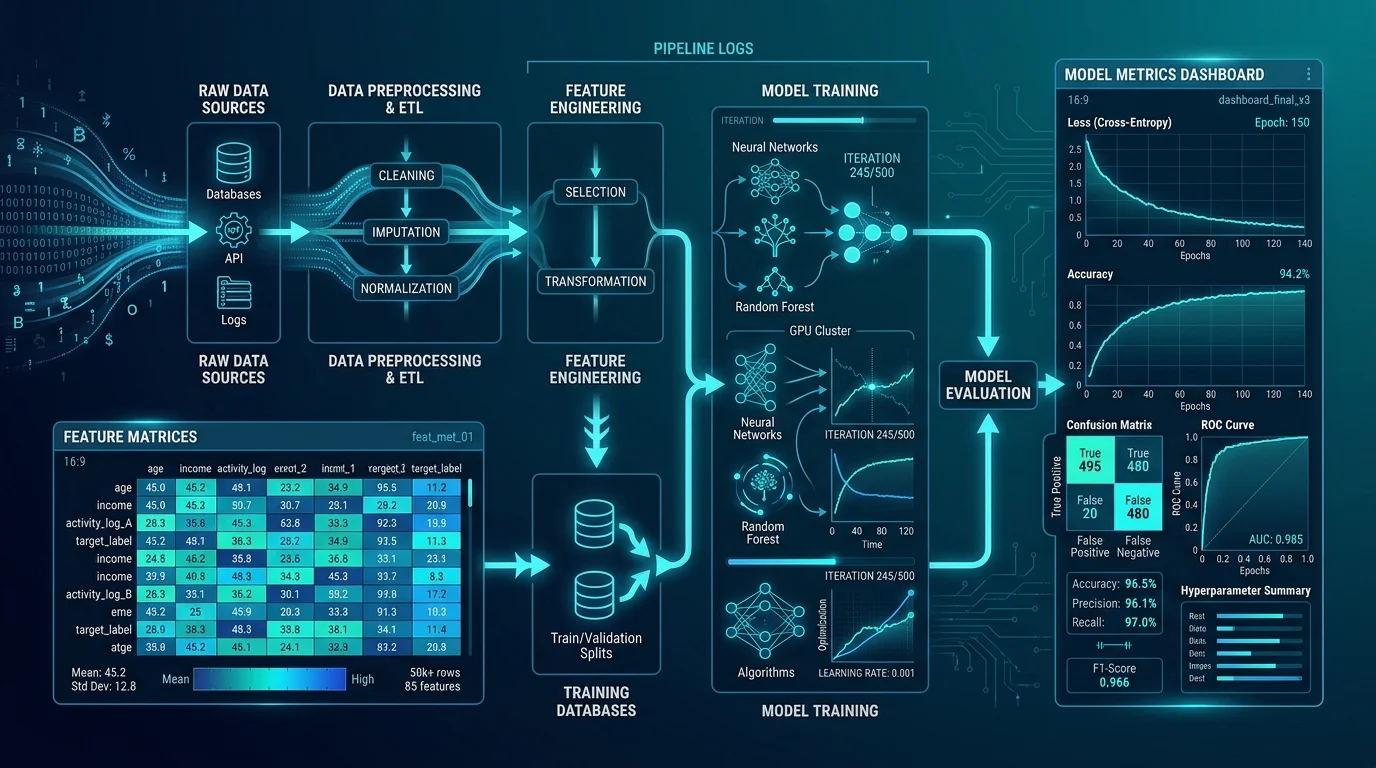
ML engineers build and maintain the infrastructure that makes machine learning work in production. Their work includes designing feature pipelines that transform raw data into model inputs at scale, building training workflows that are reproducible and efficient, setting up experiment tracking so findings can be compared and built upon, deploying models in serving infrastructure that meets latency and throughput requirements, and implementing monitoring systems that detect when models degrade. The output of an ML engineer's work is a working, production-grade ML system — not insight, not analysis, not a notebook.
The role requires both software engineering competency and ML domain knowledge, which is why it is often harder to hire for than either in isolation. A candidate who knows ML but cannot engineer at scale will produce models that work in notebooks but fail in production. A candidate who engineers well but does not understand ML fundamentals will build robust pipelines for models that are not worth serving. Finding strong ML engineers means testing both sides of this equation.
The scope of the role expands significantly with seniority. Junior ML engineers contribute to existing pipelines. Senior ML engineers design the platform architecture that other engineers rely on. At staff and principal levels, ML engineers define the standards and patterns that govern how the entire organization builds and deploys models.
Skills we screen for
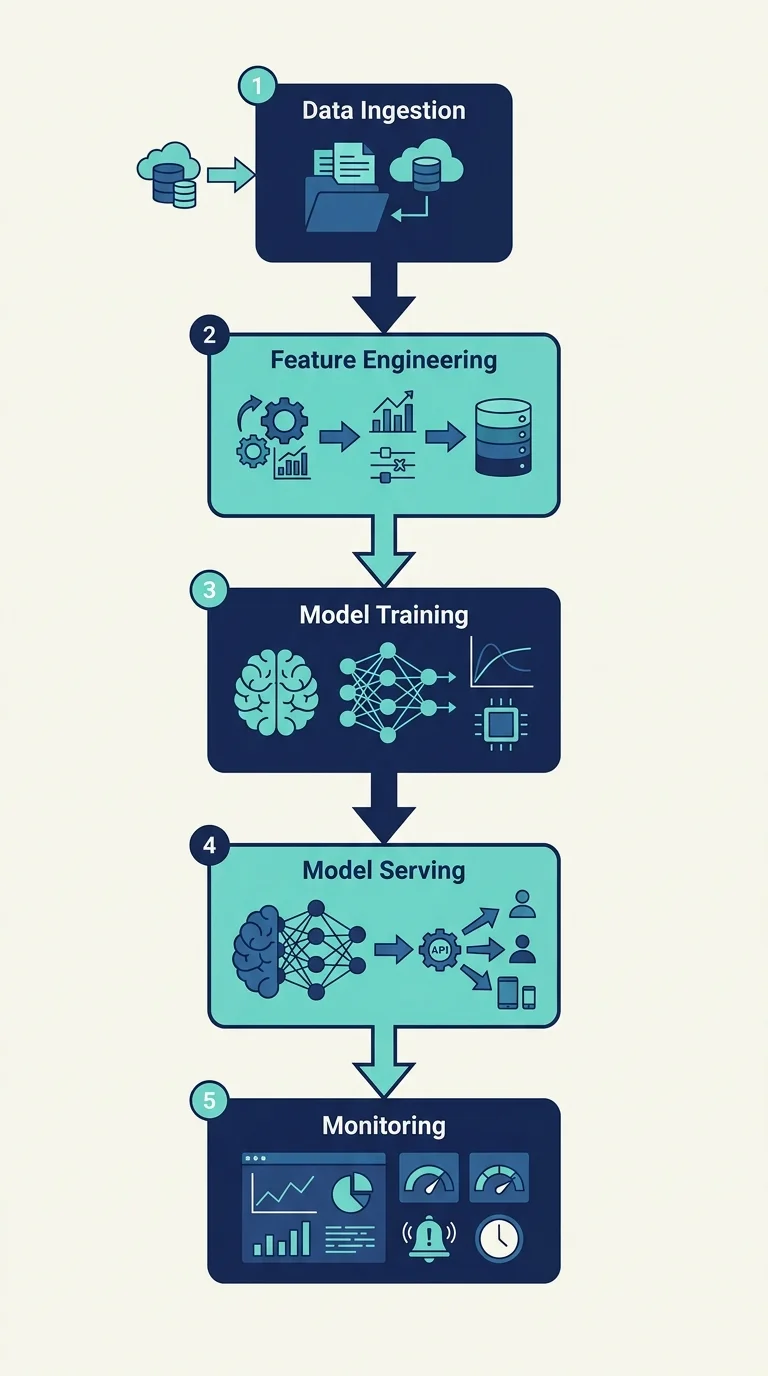
ML engineers build and maintain the infrastructure that makes machine learning work in production. Our ML engineer searches focus on candidates who demonstrate both ML depth — training pipelines, experiment design, model evaluation — and engineering execution — feature pipelines, serving infrastructure, monitoring, and production operations. Most searches get one of these right. We look for both.
Model training & optimization
- Training pipelines
- Hyperparameter tuning
- Regularization techniques
- Gradient descent variants
- Distributed training
Feature engineering & pipelines
- Feature stores
- Data preprocessing at scale
- Online vs offline features
- Feature drift detection
- Pipeline orchestration
Experiment tracking & evaluation
- Experiment management (MLflow, W&B)
- Metric selection
- Offline vs online evaluation
- A/B testing for ML
Model serving & infrastructure
- Model deployment patterns
- Latency and throughput trade-offs
- Batch vs real-time inference
- Model versioning
ML system design
- End-to-end ML system architecture
- Data and model feedback loops
- Monitoring and alerting
- Retraining strategies
How this role differs from adjacent roles
vs. AI Engineer
ML engineers build and maintain custom-trained models — they work deeply on training infrastructure, feature pipelines, and model lifecycle management. AI engineers primarily integrate pre-trained foundation models (LLMs, etc.) into products. The ML engineer's output is a trained artifact; the AI engineer's output is an application or feature built on top of existing models.
vs. Data Scientist
ML engineers are responsible for productionizing models and keeping them running reliably at scale. Data scientists are responsible for the research, experimentation, and statistical rigor that identifies which models and approaches are worth building. The ML engineer takes the data scientist's work and makes it production-grade.
How we screen candidates
ML system design
Candidate designs an end-to-end ML system — from data ingestion through model serving. We assess architecture thinking, scalability awareness, and operational maturity. Strong candidates address failure modes and monitoring without being prompted.
Technical depth
Questions on training pipelines, feature engineering, model evaluation, and serving infrastructure — calibrated to the seniority level. We probe beyond high-level descriptions to test genuine engineering judgment.
Practical judgment
Scenario-based evaluation of debugging model regressions, handling data quality issues, and managing production incidents. Assesses how the candidate responds to operational reality, not just idealized system design.
What the search process looks like
- Hiring intake to define role requirements and candidate profile
- Targeted sourcing from relevant professional networks
- Technical relevance screen before any introduction
- Shortlist presentation with candidate summaries
- Interview coordination and offer support
What we look for in candidates
A strong ml engineer search goes beyond keyword matching. These are the dimensions we evaluate in every candidate before making an introduction.
- Feature engineering and pipeline design — depth on feature stores, online vs. offline feature trade-offs, data quality handling at scale, and pipeline reliability
- Model training and reproducibility — training workflow design, hyperparameter tuning, experiment tracking, and the ability to reproduce and compare results across runs
- Experimentation and evaluation methodology — offline evaluation design, metric selection, class imbalance handling, and understanding the gap between offline and online performance
- Model serving and deployment — batch vs. real-time inference trade-offs, latency and throughput requirements, model versioning, and rollback procedures
- Monitoring and production operations — detecting model drift, data quality degradation, and performance regression in production; retraining triggers and escalation paths
- ML system design — end-to-end architecture thinking from data ingestion through feature transformation, training, serving, and monitoring
- Production trade-offs — when to retrain vs. rollback, how to handle upstream data failures, and the operational cost of keeping ML systems healthy over time

Sample screening questions for ml engineers
These are representative of the questions we use to assess candidates as part of our technical relevance screen. The goal is genuine depth and sound judgment under realistic conditions.
- 1 Design a real-time fraud detection system. Walk me through the full ML pipeline — features, training, serving, and monitoring.
- 2 Your model's production performance has degraded over the past two weeks. How do you investigate and respond?
- 3 Walk me through how you would design a feature store. What problems does it solve, and what are the trade-offs between online and offline features?
- 4 How do you evaluate a model for production deployment when your offline metrics look good but live experimentation is limited?
- 5 You need to retrain a model weekly on updated data. What does a reliable, reproducible training pipeline look like?
- 6 Your batch inference job is running three times slower than expected. How do you debug and fix it?
- 7 How do you handle significant class imbalance in a training dataset? What are the trade-offs between the approaches you would consider?
- 8 What is the difference between data drift and concept drift? How do you detect and monitor for each in production?
- 9 When would you choose batch inference over real-time inference? What factors drive the decision?
- 10 How do you structure experiment tracking to support reliable comparison and reproducibility across model versions?
Hiring for this role?
Submit your open ml engineer role and we will follow up to discuss whether the search is a fit.
Common screening mistakes for this role
Common hiring mistakes for this role
What strong candidates look like
A strong ML engineer has built a complete ML pipeline end-to-end and can speak to the specific design decisions they made at each stage — not just what they built, but why they built it that way and what they would do differently now. They understand the difference between batch and real-time inference and can reason about when each is appropriate. They have a clear mental model of how data quality problems propagate through the ML pipeline and affect model performance. They treat ML systems like production software: version-controlled, monitored, and designed to fail gracefully.
Seniority considerations
Mid-level (3–5 years)
Owns individual ML pipelines end-to-end. Makes sound technical decisions within defined scope. Understands the full model lifecycle but may need guidance on architectural trade-offs at larger scale.
Senior (5–8 years)
Designs ML systems that span multiple components — feature stores, training pipelines, serving infrastructure, monitoring. Identifies and addresses technical debt proactively. Sets evaluation standards and quality bars for model deployment.
Staff / Principal (8+ years)
Defines the ML platform strategy across the organization. Makes architectural decisions that affect how teams build and deploy models. Drives standardization and reuse. Influences model strategy alongside research and product leadership.
Hiring for a ml engineer role?
Submit the role and we will follow up to discuss whether the search is a fit for our practice.
Frequently asked questions
What distinguishes a strong ML engineer from a data scientist who codes well?
The clearest distinction is orientation. Data scientists are primarily oriented toward insight and analysis — answering questions about what the data shows. ML engineers are primarily oriented toward systems — building infrastructure that keeps models working reliably in production at scale. A data scientist's workflow is often iterative and exploratory; an ML engineer's workflow emphasizes reproducibility, reliability, and operational discipline. Strong ML engineers think about failure modes, data drift, and retraining strategies — not just model accuracy on a held-out test set.
What should a strong ML engineering candidate demonstrate?
System design ability (end-to-end ML pipeline architecture), feature pipeline engineering (how to transform raw data reliably at scale), model evaluation methodology (offline vs. online evaluation, metric selection), serving infrastructure trade-offs (batch vs. real-time, latency/throughput), and production operations experience (how to detect and respond to model degradation). The candidate should demonstrate practical engineering judgment, not just algorithm knowledge.
How do I evaluate ML infrastructure experience without running tests?
Ask candidates to walk through a complete ML system they have built — from data ingestion to model serving. Then probe: what broke in production? How did you detect it? What would you do differently now? Candidates with real infrastructure experience have vivid, specific stories about failure modes and the trade-offs they navigated. Candidates with only notebook experience will describe things that work well but struggle to speak to operational reality.
How important is deep learning knowledge for an ML engineering role?
It depends on the role. For ML engineering positions focused on classical ML, recommendation systems, or tabular data, deep learning is useful context but not the primary competency. For roles involving NLP, computer vision, or LLM fine-tuning, deep learning fundamentals matter significantly. The evaluation should be calibrated to what the role actually requires — which is why establishing a clear role brief before the search is important.
What is a good ML system design screening question?
Design a real-time fraud detection system that flags transactions at inference time. This question covers feature engineering (real-time vs. batch features), model serving (latency requirements), evaluation (class imbalance, business cost of false positives vs. false negatives), and operational concerns (monitoring, retraining triggers). Strong candidates ask clarifying questions about scale and business constraints before proposing a solution.
Should we hire an ML engineer or a data scientist first?
If your primary need is to build and maintain production ML systems — pipelines, serving infrastructure, model monitoring — hire an ML engineer first. If your primary need is to understand your data, run experiments, and generate business insights, hire a data scientist first. Many companies hire a data scientist first and then find they need an ML engineer to productionize the work. If you are unsure how to structure the role, a discovery call can help clarify the requirements.
More resources
Related roles
AI Engineer
Direct-hire recruiting for AI engineer roles — sourcing and screening candidates who build production LLM applications, RAG systems, and AI-native products
Data Scientist
Direct-hire recruiting for data scientist roles — sourcing candidates who can do the full job: statistics, experimentation, modeling, and business judgment
Hiring for an AI, ML, or data role?
Send us the role details and we will respond with whether the search is a fit.